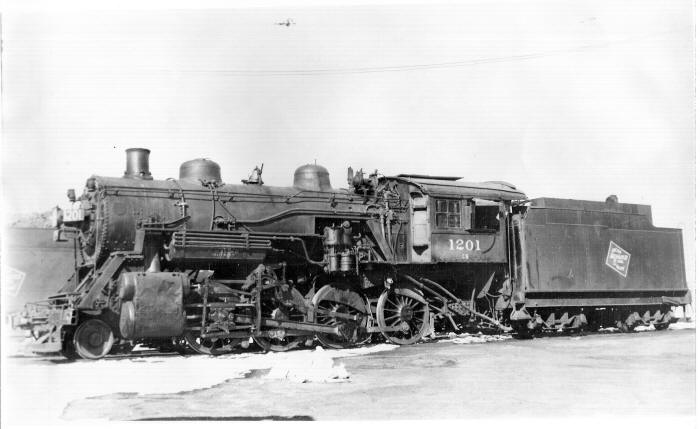
Consolidation 1201 C5 oil burning locomotive.
This 2-8-0 locomotive was one of three major locomotive classes in use
by the Chicago, Milwaukee & Puget Sound Railway in 1910.
There were a variety of other locomotive types in use, as well.
After the 1910 Fire, locomotives were converted from coal burners to oil
burners,
a safer fuel on tracks through forests.
___________________________________________________________________________________
Excerpts
from Steamboats in the Timber by Ruby El Hult, pages 134 – 137:
“In 1910 there came the most terrible forest fires the
Northwest has ever known. In that year the St. Joe Valley had ‘its guts burned
out.’ That summer no rain fell for several months. All the forests in the
Northwest became dry as shavings. By the middle of August the Coeur d’Alene,
Cabinet and Clearwater national forests had fires burning in them, but the fires
were under control and being guarded by experienced men.
“Then …[t]he Northwest … was visited by a roaring wind which
swept these fires into a flaming holocaust …
“This fire, as described in Everybody’s Magazine, ‘traveled
at seventy miles an hour, a speed greater than anything before known in
wildfire’ …
The smoke became so thick that people all over the Northwest had to keep their
lamps burning all day. Conductors on trains had to carry lanterns to read
tickets. ‘The smoke shut out the sun at Billings, Montana, five-hundred and
fifty miles distant; obscured the skies at Denver, eight hundred miles away; in
the Dakotas and down into Kansas the pall of smoke was seen in the sky.’
“In the St. Joe Valley a fire started in the Benewah Lake
region and spread up both sides of the river …
“From both St. Joe and St. Maries went emergency calls to
Coeur d’Alene for [steamboats] for rescue of the inhabitants should the towns
catch fire. The Colfax was sent to St. Joe and placed under the supervision of
Jim Hawkins, a lawyer friend of J. C. White; for three days it stood by with
steam up. To St. Maries went the Idaho and three big barges. The barges totaled
ninety feet in length and with them a bridge was formed across the river, so
that if the town started to burn the townspeople could cross to the
meadow-slough on the opposite side where there was nothing to burn and enough
water to keep them cool. It was decided this was a better plan than to try to
take a mob of panicky people downriver on the steamboat between burning hills.
… “In the Avery region many people who lived along the
railroad tracks were saved by rescue trains …
“When it was seen that Wallace could not be saved, the town
was evacuated. Rescue trains were clogged with refugees – women and children
jam-packed inside coaches, men clinging to the sides and tops. Harrison was
overrun with burned-out families; whole boatloads of weeping women and hungry
children were taken across the lake to Coeur d’Alene.”
Editor's note: The railroad through Avery was the Chicago,
Milwaukee and Puget Sound Railway. In 1910 it did not have trackage rights
into Spokane. Refugees were taken to Tekoa. At Tekoa the Oregon
Railway and Navigation Company's rail line from Portland forked, one
branch going to Spokane, the other branch going to Wallace. The O.
R. & N. was one of the rail lines that helped evacuate
Wallace. The other rail line at Wallace was the Northern Pacific Railroad
branch line that connected with its main line near Missoula, which is
where its refugees ended up.
Three Puget Sound trains took refugees from camps and sidings
into tunnels east of Avery, including the long tunnel into Montana where
refugees from Montana were brought.
One attempted evacuation of Avery apparently did not get out
of the valley. The locomotive's fireman was struck by a falling rock while
trying to remove other rocks from the tracks, rocks that the fire had
dislodged. The injured man was taken to the hospital at St. Joe,
where he died. The train returned to Avery early the next morning.